
Caribou County Most Wanted: What Exists
Caribou County publishes no official most wanted list, warrant portal, wanted count, or photo feed. The county's own pages were examined for a dated roundup, a searchable warrant tool, and a stable photo page. None of them offers a verified, person-level wanted inventory.
The Caribou County official hub and the Caribou County Sheriff site remain the right places to start, since they route you to the current county and agency contacts. The Sheriff's site covers detention, news, patrol, dispatch, and general contact information. Its Caribou County Jail detention page handles facility and booking questions, but it is not a warrant roster. None of these official pages promises a live warrant result by phone or web form.
That negative finding needs careful wording. It does not mean no Caribou County warrant exists. A most wanted list is a curated outreach tool, limited to cases an agency chooses to spotlight. A warrant check, by contrast, asks whether a specific court or law enforcement record exists and is still active. Those are two different questions. Any future official list should carry its own issue date, source agency, tip instructions, and safety language, and any photograph should stay on the custodian's own page rather than a copied gallery.
The Caribou County official hub routes visitors to county offices and the Sheriff. It is navigation, not a public wanted roster.
County navigation can point you to the right agency without handing over a live list. A search result, an old domain, or a third-party claim cannot fill that gap.
Caribou County Wanted-List Fields
No current Caribou County list is in place. So treat the fields below as a checklist, not live entries. They describe what a future official page should display before anyone relies on a wanted notice. They also explain why a name or photo alone can't establish current status.
| Field | What a future official list should verify |
|---|---|
| Publishing agency and URL | Name the current custodian and use a county-linked official address, not an old redirect or an SEO page. |
| Issue and update date | Show when the notice was posted or checked so a reader can judge whether the status may be stale. |
| Name and identifiers | Give the name and lawful descriptors used by the agency, while avoiding guesses based only on a face or similar name. |
| Photo provenance | State whether an image came from the Sheriff or another custodian and whether the image is still current. |
| Warrant or case basis | Identify the warrant type or public case number when disclosure is allowed. Unreturned records may be exempt. |
| Charge wording | Use the source's charge language and call it an charge. A wanted notice is not a conviction. |
| Status and last review | Say whether the notice remains active, was withdrawn, or was resolved, with a source date for each change. |
| Tip and safety instructions | Give only the official contact route and state anonymity or reward terms only when the agency publishes them. |
A responsible list would also state its limits. It should not imply that every warrant appears. It should not suggest that everyone shown is in custody, or that a photo proves identity. Absence from a curated list does not equal a clean record.
Note: A curated wanted notice cannot establish current custody, a conviction, or the full universe of warrants in Caribou County.
How to Read Caribou County Wanted Information
Treat any future Sheriff notice as a dated public alert, not a live location tool. Read the full entry. Confirm the issuing agency. Keep the terms straight: a warrant authorizes police action, a booking records custody, and a court case tracks what was filed and later decided.
- Start at the current county or Sheriff site. If a wanted page is not visible, stop there and do not substitute an old Sheriff domain or an unverified list.
- Read the posting date, status, exact name, warrant or case reference, and safety warning. Do not treat a photo, a similar name, or a search snippet as confirmation.
- Check the issuing agency. Soda Springs has its own police department, while Sheriff patrol and dispatch serve Soda Springs, Grace, Bancroft, and the wider county. The city where an event happened does not by itself identify the record custodian.
- If you recognize someone, do not approach, follow, confront, or try to detain that person. Use the official contact route and report only what you know, such as the notice, location, and immediate safety facts.
- For a related booking, custody, or court-record path, use the Caribou County arrest and booking records search. A later booking would still be an charge or custody event, not a court finding.
No Caribou County wanted page with photos exists to browse or copy. If the Sheriff publishes one down the road, the official source should stay the place to view any image, and its status should be rechecked before you send a tip.
Note: A photograph or similar name is a lead for verification, never a safe basis for personal contact or public accusation.
Caribou County Tip and Safety Contacts
Caribou County has no separate Crime Stoppers number. There's no published anonymous-tip promise, no reward schedule, and no "warrant Wednesday" feature. That gap matters. Don't assume anonymity or a reward. And never send a tip to an unverified page borrowing the county's name.
Caribou County Sheriff
475 East 2nd South
Soda Springs, ID 83276
Main: (208) 547-2561
Booking: (208) 547-3094
Dispatch / non-emergency: (208) 547-2563
Use the main line for records questions. Use booking for jail custody. Use dispatch for a time-sensitive safety report. When you call, share the source notice, the location you observed, and only facts you know firsthand. Nothing in the official materials guarantees a call is anonymous or rewarded.
Do not approach or detain anyone. A wanted claim, a court result, or an online name match is never a safe basis for contact. Move away. Don't follow. Send what you saw to law enforcement through the published route, and use emergency services only for an immediate threat.
Presumption of innocence. A warrant, booking, or charge records an allegation or a custody event. Charges can be reduced, amended, or dismissed, and only a public court disposition can describe the outcome of a case.
Caribou County Warrant Check Steps
Caribou County offers no public warrant-search portal. The official Sheriff contact and Idaho iCourt are partial paths, not a full warrant database. A safe check asks both the court and the law enforcement custodian one narrow question. Give enough identifying detail to avoid mixing up two people or two jurisdictions.
- Define the question first. Decide whether you need current custody, a public case, a past booking, or a warrant-status answer. Gather the person's full name, the county, and an approximate date or case number if known.
- Search the Idaho iCourt Portal using the name and county. The portal provides public case and hearing searches, requires browser scripting and cookies, and warns that sealed or exempt matters do not appear.
- Record the case number, filing date, charge wording as filed, hearings, and public status. A case result can help identify the right file, but it does not necessarily show whether an unreturned warrant is currently executable.
- Contact the Caribou County Sheriff through the main, booking, or dispatch route listed in the contact card below. Ask which office can verify an agency-held warrant record and explain that an online case search did not answer the live-status question.
- Contact the relevant court clerk for a public case-file or access question. The clerk is the custodian for district- and magistrate-court case files, while the Sheriff is the practical route for an agency-held record. Ask for the correct custodian rather than requesting a sealed file.
- If the answer is withheld, redacted, or unavailable, ask which public-record rule applies and whether a segregable record or a different custodian exists. Do not treat a missing web result as proof that no warrant exists.
- If the question concerns you, ask an attorney or the court what lawful next step applies. Do not try to evade, confront, or privately resolve a suspected warrant.
Use the source date in your notes. A court case, a jail booking, and a Sheriff warrant record can update on different schedules. A public court disposition may explain the legal outcome, but it does not by itself confirm current custody.
Note: A public iCourt result can identify a case, but it cannot guarantee that an unreturned warrant remains active.
Caribou County Warrant Types
Not every warrant works the same way. In Idaho, an "unreturned" warrant is one whose service or return has not been reported back to the issuing court. Here is the catch for a public search. Idaho Court Administrative Rule 32 treats certain warrant records as exempt or leaves their release to a judge's discretion. No public lookup can promise a full picture of active warrants in Caribou County.
| Record type | What it means | Why the web result may be incomplete |
|---|---|---|
| Arrest warrant | A court process authorizing officers to take a named person into custody. | ICAR 32 identifies unreturned arrest warrants, other than bench warrants, among records that may be exempt. |
| Bench warrant | A court-issued warrant tied to a court matter; the court record supplies the specific reason and status. | It is treated differently from an unreturned arrest warrant in the rule, but iCourt still is not a live warrant database. |
| Search warrant | A court process authorizing a search of a place, person, or property; it is not automatically an arrest warrant. | Unreturned search-warrant information may be exempt, and law-enforcement disclosure can be discretionary. |
| Summons or notice | A direction to appear or respond. It is not the same legal process as a warrant. | Summons records can be treated differently from warrants, so a case result needs careful reading. |
Be careful about calling any of these people "wanted." The label fits some records but not others. A summons only asks someone to show up in court. It does not carry the custody power of an arrest warrant. A search warrant targets evidence, not a missing person. Before you assume anything, ask which record type you are looking at and which office holds it now.
Note: Warrant, summons, and search records have different legal purposes, so the label matters before any status conclusion.
Caribou County Court Path
Start with the Idaho iCourt Portal, the main public case-search route for Caribou County. It can show a case number, the filing date, the exact wording of filed charges, and hearing or arraignment details. You may also see a disposition. That is simply the court's final result or current status in the case. An arraignment, for reference, is one of the first hearings after a case gets filed.
The Idaho Judicial Branch's court-record access guidance walks through iCourt, clerk requests, public-record options, and the ICAR 32 limits. The Caribou County courthouse sits at 159 South Main, Room 202, in Soda Springs, Idaho 83276. Bring a case number when you contact the clerk. A booking description alone can get matched to the wrong file.
ICAR 32 matters most for warrant questions. The rule lists unreturned search warrants and unreturned arrest warrants, other than bench warrants, among records that may stay exempt. Law enforcement also keeps some discretion over what it shares. The clerk and the Sheriff may hold different files and give you different answers for that reason. A search that comes back empty could mean sealing, exemption, juvenile status, a misspelled name, or the record sitting in another county. It does not prove nothing ever existed.
The Idaho court-record guidance capture lays out the court system's access route along with its ICAR 32 reference.
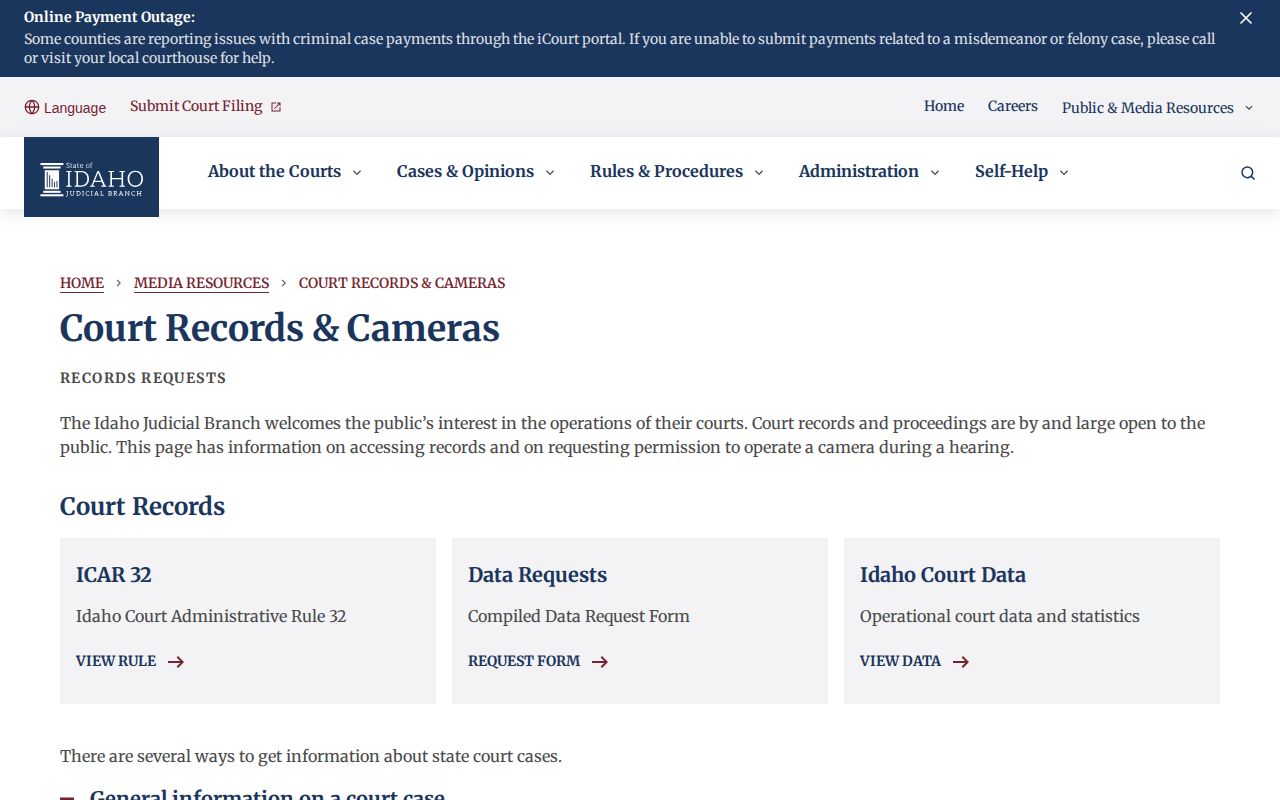
Courts can tell you where a case stands. They cannot serve as a live warrant search. Treat the court route and the Sheriff route as partners. Pay attention to what each one actually proves.
Note: A court search is one part of a status check because sealed, exempt, juvenile, and unreturned records may not appear.
Caribou County Alerts Are Not Wanted Feeds
The Sheriff does not run a branded app or a steady booking feed on social media. The official site offers two notification tools instead. One is Caribou County ALERTS, and the other is VINELink. AlertSense pushes emergency messages. Think hazards, evacuations, civil danger, and missing persons. It is not a booking roster, a warrant list, or a photo source of any kind.
VINELink handles custody status and victim notification. That is its whole job, and a legitimate official route, so check its coverage when you use it. The state adds its own caution too. The Idaho Department of Correction victim-rights information page flags gaps in IDOC VINE activity. There is also the Idaho Department of Correction resident/client search, but that covers state custody and supervision rather than the Caribou County Jail. None of these tools replaces a direct check with the Sheriff or the court record.
Caribou County Warrant Records by Request
Sometimes a narrow question just needs paper. The Caribou County Sheriff public-records form is the documented way to ask. It wants your contact details, a clear description of the record, your preferred delivery method, and an electronic signature. Reports and photos appear in the form's own examples. Filling it out is a request, not a guarantee. The office may not hold everything you ask for, or may not be able to release it.
- Identify the arresting or issuing agency, event date and time range, location, and any incident, case, or booking number.
- Use the full name only when needed to locate the record, and describe the exact warrant, booking, or case record sought.
- Ask whether the record is held by the Sheriff, the court clerk, Soda Springs Police, or another agency.
- If a record is withheld or redacted, ask for the cited exemption, a segregable version, and any transfer or retention explanation.
- Request an estimated fee and response timing before work that would create a charge.
Soda Springs keeps its own public-information request form, and it includes a City Police Department option. That choice matters. An incident in Soda Springs could belong to city police, the Sheriff, Idaho State Police, or another agency entirely. The Sheriff's patrol and dispatch pages show county service in Grace and Bancroft. Still, the agency that made the arrest holds the record.
Keep the request tight. Asking for every warrant or photo across a wide date range invites confusion. A focused request gets a straight answer from the custodian about whether a record is public, protected, transferred, or gone. Read any response carefully before drawing conclusions about custody or warrants. Know what was actually searched first.